
Residential sewer lines
Sewer Pipe Relining for Australian Homes
The house sewer is the line every fixture depends on, and it's usually the hardest one to reach — buried a metre or more down, often running beneath a driveway, garage slab or garden. Relining lets many of those lines be repaired without opening the ground above them.
Why residential sewer lines fail
A large share of Australian homes built before the 1980s still run vitrified clay or earthenware sewer pipe in short lengths with mortar or rubber-ring joints. Those joints are the weak point. Ground movement, reactive clay soils, heavy vehicles overhead and decades of settlement gradually pull them out of alignment.
- Displaced or open joints — a step in the pipe that catches solids and lets roots in.
- Circumferential and longitudinal cracks — often from soil movement or load above.
- Root intrusion at any opening, drawn to the moisture inside.
- Recurring sewer blockages that clear for a few months and come straight back.
- Deteriorated pipe surface in older lines, roughening the bore and slowing flow.
Signs the sewer line itself is the problem
Multiple fixtures backing up at once, gurgling from floor wastes or a gully overflowing after heavy use all point downstream rather than to a single fixture. If a drain has been cleared more than once in a year, the fault is more likely structural than behavioural — that pattern is covered in more detail on recurring blocked drains.
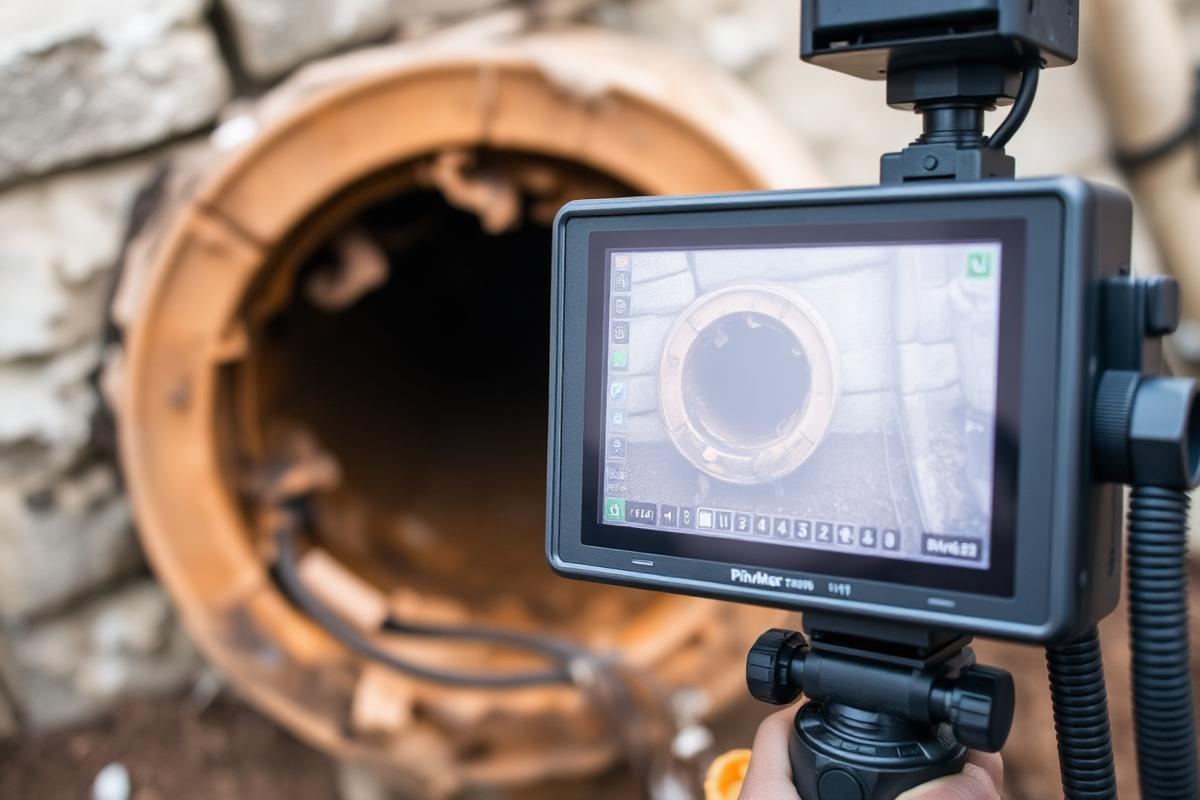
Relining sewers under driveways and slabs
Where a sewer runs under a concrete driveway, a garage slab, a pool surround or the house itself, the excavation cost is rarely just the digging — it's the saw-cutting, spoil removal, backfill compaction and reinstatement afterwards. That's the scenario where a no-dig repair changes the arithmetic most. Access is generally taken from an existing inspection opening or a small entry pit well clear of the finished surface.
When a sewer can't simply be lined
A liner needs a host pipe with enough remaining shape to press against. Fully collapsed sections, pipes crushed under load, or lines with a deep sag holding water are usually excavation jobs — sometimes a short dig to repair one section, followed by lining the rest. A specialist should explain the reasoning from the footage rather than defaulting to one method. Our relining vs replacement comparison sets out where each option makes sense.
Sewer vs stormwater
Sewer carries waste to the network; stormwater carries rain. Both can be relined, but the diagnosis, authority requirements and consequences of failure differ.
Property boundary
Responsibility usually ends at the connection point to the network. A specialist can confirm which section is yours before quoting.
Costs
Sewer work sits within the general A$500–800 per metre orientation, with depth and access driving the variation. See the cost guide.
Evidence
Ask for before-and-after CCTV. It's the only practical record of what was actually repaired underground.
Next steps: read how pipe relining works, check pipe relining costs, or, if roots are the suspected cause, tree root pipe repair options.
Get a pipe relining quote
- 1Problem
- 2Inspection
- 3Contact
Your postcode helps us identify specialists servicing your area. We don't need your street address at this step.
Ready to get pipe relining quotes?
Describe the problem, enter your postcode and submit your enquiry. We help match pipe relining enquiries with suitable specialists servicing your area.